Critical Narrative



Objects are everywhere, whether we (as consumers) consciously notice or not. As we go about living our day-to-day lives there is a lack of attention paid to the objects that we frequently use. People grow accustomed to the use and frequent visibility of objects, which produces ignorance to the values, stories, and messages that these objects represent. Such objects provide meaning even if it may seem that they have such a miniscule role in our lives. As Arthur Asa Berger discusses in his novel, What Objects Mean: An Introduction to Material Culture (2009), “objects provide information about what we are like and how we live now - and how we lived in earlier times.” (16) He builds on this notion by providing multiple frameworks on the examination and understanding of objects, and refers to the idea that “the objects tell you about the culture, and the culture tells you about objects.” (20) The study of objects makes room for the understanding of culture, values, people, histories, and stories. In this regard, everyday we do not realize the knowledge and enhanced perspectives that we could benefit from by just stopping and looking at the things around us.
Berger provides insight on a variety of theories that can be applied to the study of material objects. There are an array of different perspectives, each of which recognizing Berger’s overarching theme that “theories are like goggles that help determine the way we see the world, that point our attention to certain things and that distract us from others.” (23) In this sense, it is important to note that the lenses in which we see things is different for everyone, and in this case, for every theorist. Hence, every perspective contributes significantly to the overall learning and understanding of objects for the audience. He describes a Freudian Psychoanalytic Approach, different types of Semiotic Approaches, a Sociological Approach to analysis, a Marxist approach, a Cultural approach, and an Archaeological approach. Again, all of which provide a unique and useful framework in studying objects of material culture, and have been significantly helpful in examining a specific object of focus here at Bates College.
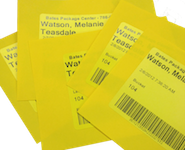
A package slip distributed from the mailroom is seen to many as just a simple yellow piece of paper that functions as a reminder and necessity to picking up a package or a piece of mail in the package center. Is that it? Is that all that the package slip represents? The majority of students at Bates do not even think about what its’ function is, it’s more of a reflex or subconscious action to check one’s mailbox, get your slip and head to the package center. Is there further thought behind that idea?
Using the Freudian Psychoanalytical approach to material culture as presented in Berger’s novel will provide an interesting and intelligible approach to examining Bates’ yellow package slips. Freudian theory revolves around the idea that “unconscious mental processes exist and play an important role in our lives.” (27) With this, Berger adds, “It is the hidden meanings and symbolic significance of various artifacts of material culture” that must be uncovered when using Freud’s framework in examining objects. Berger supplies the foundation to critically investigate the package slip. One of the major aspects of Freudian theory is the Topographic Hypothesis, which introduces three levels to the human mind. The first level is consciousness, which is defined as “what an artifact does,” the second level is the preconscious, “other aspects of the artifact’s functionality of which we may be aware,” and the third level is the unconscious, which is “unrecognizable symbolic meanings connected to the artifact.” (28)
While using the Freudian analysis, we first must note the conscious. In other words, in this theory it is key to fully understand the function of the object and how it is used in everyday life here at Bates. The object examined in this research is the Bates College package slip. The employees who work in the mailroom, place a yellow piece of paper in the mailbox of the person who has received a package or post. The student will come to check their mailbox and if they have a yellow slip, it means they have a package or a piece of mail. Thus, the function of the package slip is to inform a student when they have received mail or a package. It serves as a form of communication and notification. Thereafter, the student will walk to the package center and hand in their slip along with a quick flash of their ID (to prove that they are indeed the person whom the slip was supposed to go to). The employees in the package center will scan the slip (as it has a barcode on it that corresponds with the package/mails’ barcode), scan the parcel, and with a quick signature, the student is out of there with a package or piece of mail in hand. So what happens to the package slip? The yellow package slip gets thrown into the trash. As these package slips live a short life, they have a major effect on the lives of Bates students whether the students realize it or not.
Who would ever question the implications or messages that the package slip represents? It is curious as to the reasoning for such. Have we become so numb to observation and paying attention to the present life? If so, we risk losing the meaning of things and the stories behind objects, which is the basic foundation of learning, education, and experience. Thus, it takes a toll on the construction of life. By looking specifically at the package slip, we are able to grasp a hold on the significance of the meaning of objects and see how there is so much more to be learned from everyday objects.
This brings our analysis to the second level of Freud’s Topographic theory, which is the preconscious. Again, Freud describes this idea as the parts of the object that we are “dimly aware of” (28). In this investigation of the Bates College package slips, the preconscious is a connection that is created with the students through the feeling they receive when they are given a package slip. Seeing a slip in one’s mailbox is exciting and for the majority of students. As students do realize that specific concept of the object, it is blurry as to the full influence that this object has on the students. This great feeling that a student gets when they get a package slip, also contributes to a genuine feeling of importance and appreciation. Someone (regardless of who) made an effort to physically send a piece of mail or package to you, thus, is thinking about you and cares to reach out. For a simple piece of paper to have such an influence on one’s emotions supports the overarching theme in this research, that with objects, “there’s more that meets they eye.” (28) Thus, objects have meaning, and that meaning can influence us consciously, preconsciously, and subconsciously. Though, all of which have a profound impact on our understanding of people, our culture and ourselves.
This dynamic of the subconscious comes into major effect in this examination, as it is the third level of Freudian Psychoanalytical Theory. Berger describes this aspect of the theory by describing the idea that “we are not conscious of the symbolic significance and importance of the artifacts we purchase or use.” (29) As mentioned earlier, Bates students go about their everyday lives not recognizing the objects around them, and the objects that are used daily. Analyzing the package slip at this step of Freudian framework introduces some interesting facets about these objects that one would not think twice about in retrospect. In this way, Bates students are in contact with the meaning of the package slips without even realizing it. These package slips provide a message to the people using them and an insight into the people at Bates College. Berger further explains this idea by noting the importance that, “meanings that are varied, can change in time.” (82) So what exactly are these yellow pieces of paper telling our subconscious? What is the story here? What message are these simple pieces of paper conveying?
The package slip provides a representation of the current changes that are taking place in the world. With globalization and the need for states to become more influential in the global arena, comes this idea of increased communication. In which case, has been handled by technological advancements. Within the past decade, technology has increased dramatically, as the Internet, e-mail, social media, phones, computers, and more, have all changed entirely. It is much easier to communicate and connect with people now, as all one has to do is send a quick text to mom or dad, or Facebook poke a friend from afar. But what kind of connection is this? The package slip takes one back to an earlier time, when personality could be conveyed through penmanship, and one was able to physically hold a letter written from a loved one or experience the emotion that the writer put into the use of systematically chosen words.
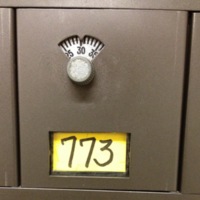
These package slips become a constant reminder of the loss of true connection with people and ourselves, and a loss of identity. There is a kind of intimate experience through the physical act of writing that can be seen through word choice, style of writing, and the effort put into a parcel. Personality is evoked through writing and signifies one’s values, and in our day and age we have become detached from this personal experience. Technology continues to grab hold of consumers and pull them away from the evocative nature of emotion presented in writing. As we go through the motions of life on Bates campus, the yellow blur that can be seen through your mailbox window provides a peak at the increasing separation between profound and meaningful communication and our obsession with the effortless accessibility that technology provides.
The big question that the critical analysis of this object suggests is, will Bates College be able to hold onto the mail system as it becomes less and less used as a means of communication? As this is unanswerable at this point in time, it does not fully withhold the ability to predict. In which case, it is likely that over time the use of the actual paper package slips will end, as technology (the use of an e-mail) may clear the way for an “easier” way to notify students when they have a parcel. Along with that, it seems to be a trend that the use of actual mail and letters will disappear more substantially. Therefore, is this implying that in the future Bates College will not even need mailboxes? Again, this is all left to prediction based on the advancements of technology and a constant strive towards making things easier and more accessible, but such predictions are reasonable to assume.
As Berger presents the Freudian Psychoanalytical Approach to material culture, it provides a deeper insight into the meaning of an object and the influence that that meaning has on the mind, consciously or subconsciously. Using Freudian theory, one is able to deepen understanding of objects and realize their significance in everyday life, (as such significant factors are normally overlooked).
Works Cited
Berger, Arthur Asa. "What Objects Mean: An Introduction to Material Culture." Left Coast Press: California, (2009)