
Historical Narrative
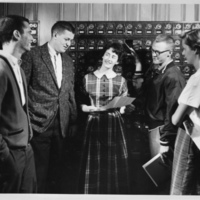
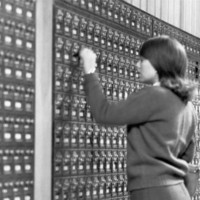


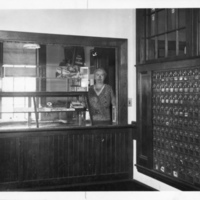
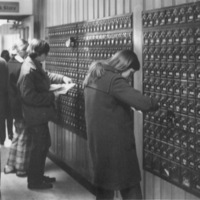
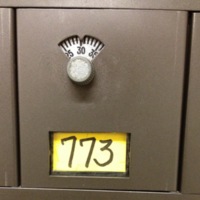
Over the last 140 years at Bates College the mail system has been a topic that is constantly discussed by the student body in order to make it as convenient and efficient for all students. Several articles from The Bates Student show a general trend in history regarding changes in the mail system. It appears that students have requested changes, voiced their opinions and proposed solutions to the problem long before the school decided to take action and implement any modifications. Even though many alterations to the mail system have been made over the past century at Bates, the articles written in The Bates Student reveal that the student body has constantly seen the need for improvement in the system and has never seem to be fully satisfied with the way the system has worked throughout history.
In 1873 Bates students began to voice their disapproval of the Bates mail system. Frank Moulton, a student at Bates during this time, wrote in The Bates Student: “We wish to say a word or two about the system, or rather lack of system, by which our mail matters are managed. The present custom of having the mail man carry our letters to the post office and distribute the mail on his return, is found to be decidedly inconvenient, and the frequent growls at the present arrangement lead us to think that a change would be advisable” (p.105). During this time the mail system was extremely unorganized and unpredictable. The mail carrier would arrive at Bates at different times each day with the mail. If the students were there at this time, the mail carrier would distribute their mail to them. The mail carrier would leave all of the extra mail whose owners were not present in a box in Chase Hall. This mail was left in the open and the students were allowed to go through the mail freely to find their letters and postcards. If students were not able to come receive their mail right when the mail carrier arrived, their mail was often tossed around the room and sometimes other students even opened it. In this article, Moulton proposes a solution to fix the mail system at Bates. He writes, “We suggest as a remedy for the case under consideration, the establishing of a post office at Parker Hall. Our idea would be to have the mail man carry down and bring up the mail as usual, but instead of distributing the letters to each one, place them in the boxes (which should all be lock-boxes) where each student could get them whenever it suited his own convenience” (p.105). Moulton acknowledges the fact that this would add more work to the mail carrier’s job and may take him more time, but Moulton believes that his time would be well spent because it would make the lives of the students far easier and it would help the mail system at Bates run more smoothly. Moulton’s article was well written for it expressed what the problem was, why it was an inconvenience to the students and it suggested a solution for the school. Articles written after this one demonstrate that Moulton’s article was not taken very seriously, for no changes were made for many years after it was published.
Eleven years after Moulton’s article was printed in The Bates Student, a complaint article was written in the editorial section of The Bates Student. This article was written in 1884 and not a single change to the mail system had been made during this time. This article discusses a specific incident in which a student opened three pieces of mail that did not belong to them. The author of this article recognized that the mail system at Bates was flawed, but the purpose of the article was to ask people to please respect one another’s property even under the circumstances they are in with the poor mail system. The author wrote, “We acknowledge that the system of delivery is faulty, but as long as it remains as it is at present let every one remember and ‘do unto others as you would that they should do unto you,’ with respect to mail at least” (p.52). The tone of this article alludes to the fact that the students are tired of complaining about the system and trying to get the school to change it because the school has not listened to any complaints prior to this time. Instead of continuing to complain about the system, this student makes it their goal to explain to the students that they need to make it work for themselves and respecting one another’s property is a step in the right direction.
In 1885, students continued to voice their dissatisfaction and the complaining continued. E. Varney and A. Verrill wrote an article that explained the current issues they had with the system. The students explained that the mail is brought in and put in a box, which was “open to the inspection of any one desiring to examine its contents” (p.25). They said that the system caused stress in the students life and was a constant worry for them: “…it is not pleasant to feel that one must run when he sees the postman coming, or otherwise trust to luck for ever obtaining his mail” (p.25). The fact that students had to hope that they would be lucky enough to find their mail when they finally arrived to the box is very discomforting for the students. During this time, mail was one of the few forms of communication for people and it was very important for students to receive their letters. The students had enough going on in their lives that the mail system should not have been one of their largest sources of stress and anxiety. This student ends the article by asking the faculty for their opinions: “Can there not be some remedy for this? We would respectfully invite the faculty to help us answer this question” (p.25). It seemed that the students felt they had brainstormed enough solutions and it was time to get the faculty more involved in order to facilitate a change.
In 1886 and 1888 articles were written again on to discuss this topic, however, the tone was more demanding in these articles. In 1886 the article states that all students at Bates would like to change the mail system and they suggest a plan similar to those suggested in past articles. They proposed that the college put lock boxes in and the mail carrier would put each person’s mail in his or her box. The author adds that in order to pay for these boxes a slight tax for each student per term could be incorporated. At the end, the article demanded early attention and explained that if the faculty does not come up with another solution, then they will assume the school will use the idea that they proposed. As the trend has gone so far, no changes were made. In 1888 a very angry article came out in The Bates Student. The author wrote, “About a year and a half ago an editorial appeared in the Student, asking if something could not be done to provide a better place for the college mail. Nothing has yet been attempted, and we still gather round that little box, where everybody can pull over letters and papers and examine the postmarks, and read the postal cards, however much it may discomfit the owner” (p.31). It is clear that the students felt that they voiced their opinions sufficiently and they began to get very angry with the school for not listening to their needs. The article ended with this statement: “If the college authorities are unwilling to remedy the evil, let the boys take the matter into their own hands. The present condition of affairs is a positive disgrace to the progressive spirit of our institution” (p.31). The students feel that Bates is a progressive school and part of being progressive is listening to their community members and making changes based on the needs of the people. This problem demonstrates the disconnect between the students and faculty at Bates during this time.
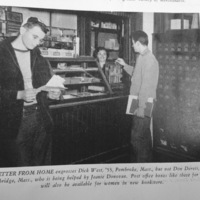
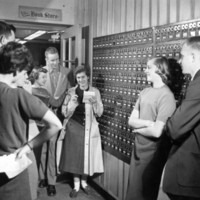
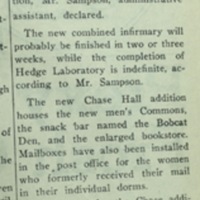
In 1919, 46 years after the first mail system complaint in The Bates Student, Bates College put mailboxes on campus in Chase Hall. Unfortunately, these mailboxes were created only for men to receive their mail. The old system stayed in place for the women. This system stayed in place for 31 years. In 1950 many changes were made to Chase Hall, one being the addition of mailboxes for the female students at Bates. The 1950 issue of The Bates Student explained that packages for the students were sent to the student’s dorm rooms. They could receive their packages at their dormitory between the hours of 10am and 2pm.
It took almost 50 years for students at Bates to convince the school to install mailboxes to receive their mail at Bates. Once these mailboxes were put in place, other problems seemed to arise. The students felt that the post office, where the mailboxes were located, was not open long enough and was open during inconvenient times of the day. Between 1919 and 1950, when only the men had mailboxes, the men could access their mail whenever the school store was open, which was Monday through Saturday, 8:30am to 4:30pm. In 1950, the school cut down the hours of the post office to 3.25 hours a day and 1.5 hours on the weekend.
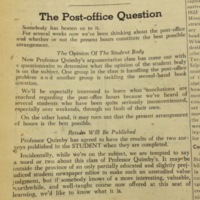
As talk about the inconvenience of the post office hours continued, a group of students decided to research this issue more in depth. A group project was assigned to a class at Bates, run by Professor Quimby. The class was split in half and their assignment was to identify a problem at Bates, research it, and propose possible solutions for the problem. One group decided to research the inconvenience of the Bates post office hours. A questionnaire was sent out to 462 people, 202 men and 260 women. The group found that “two hundred and thirty-five said they didn’t think the post office was open long enough, while 167 were satisfied with the present duration of time. An even greater majority expressed dissatisfaction with the present hours if only three and a quarter hours were available; 123 thought the present times were best; 252 wanted another arrangement of hours” (p.113). The group interviewed President Phillips, the president of Bates College during this time, to propose their solution and hear his opinion on the matter. The group recommended that the post office go back to its old hours, Monday through Saturday 8:30-4:30, in order for it to be convenient for the student body. The president denied their solution and explained that the hours were cut due to budgeting. He said the school did not have enough funding to pay for the electricity for the post office to be open all day. He did agree that the hours could be changed to suit the convenience of the students.
Between 1950 and 1978, the hours of the post office did go back to the previous time with the exception of weekends and the yellow package slips were added to the Bates mail system. In 1978 the post office was open Monday through Friday 8:30am to 4:30pm and it was closed on weekends. When a student received a package, a yellow package slip was put inside their locked mailbox and the student brought the slip to the post office or package center in order to obtain their package. Judson Hale, a 1982 Bates graduate, expressed his thoughts about the mail system:
I never really had a big problem with the system; however, I did feel it was inconvenient that the package center was not open on weekends. If your package arrived in the late afternoon on Friday then you had to wait until Monday to receive it. Sometimes my mom or my friends’ mothers would send cookies and they would be stale by then! Besides that, I thought the system worked fine. I trusted the system and always knew my mail would get to me. I never worried about that.
It appears that the system in 1978 was very similar to the mail system Bates uses now. Some of the same complaints are heard around campus regarding the weekend hours, however, students have not openly voiced any concerns recently about their opinions on the Bates mail system. After a lot of effort and push from the Bates students over the last 140 years, the Bates mail system has made great strides to becoming a system that is easy, convenient, and trustworthy for the student body at Bates College.
Sources Cited
"A Chance to Criticise." The Bates Student. Vol. XLVII. N.p.: n.p., n.d. 116-17. Print.
"Arg Class Reports Post Office Query." The Bates Student. Vol. 77. N.p.: Class of 1950, n.d. 3-114. Print.
"Editorial." The Bates Student. Ed. Roscoe Nelson, Israel Jordan, and E. Hayes. Vol. XIV. Lewiston: Class of '87, 1886. N. pag. Print.
Jones, Robert. "Many Student Needs Center in Bookstore." The Bates Alumnus Issue. By Carol Patrell. Vol. 9. Lewiston: n.p., 1950. 405-06. Print.
Moulton, Frank. "Editors' Portfolio." The Bates Student. Ed. Frederick Standford and Henry Chandler. Vol. 1. Lewiston: Class of '73, 1873. 105-06. Print.
Small, and F. Daggett, eds. "Editorial." The Bates Student. Ed. C. Emerson. Vol. XVI. Lewiston: Class of '89, 1888. 30-31. Print.
Stiles, E., and C. Washburn. "Editorial." Ed. A. Morrill. The Bates Student. Vol. XII. Lewiston: Class of '85, 1884. 51-52. Print.
Varney, E., and A. Verrill. "Editorial." The Bates Student. By W. Hatshorn. Vol. XIII. Lewiston: Class of '86, 1885. 25-26. Print.