Critical Narrative
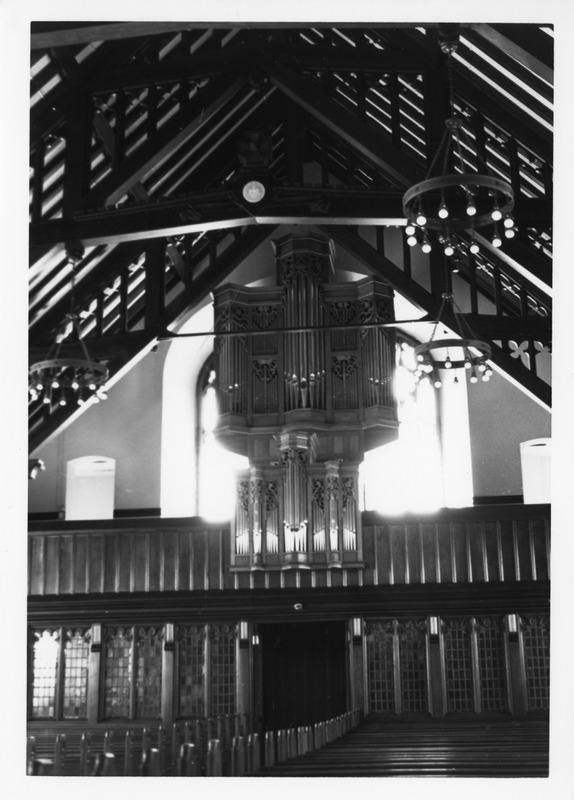
Material Culture is the study of how artifacts relate to society. Examining this relationship can be fruitful as one might discover information inaccessible in narratives. In particular, artifacts at Bates College offer a unique gateway into the school’s culture. The Bates Organ, located in the Chapel, is one such artifact. There have been three Organs in Bates’ history, the first one was built in 1913, the last in 1982. The organ’s long, important history to the College ensures a perspective that Material Culture enthusiast will be well rewarded for conducting a critical analysis.
A look into Bates’ financial incentives for maintaining the organs is an interesting place to begin this analysis. As one of the largest instruments in the world, maintaining an Organ is an onerous financial task for any institution. Bates has maintained three different sets of organs for a century. The amount of time and money that Bates has dedicated to ensuring the school has a working organ indicates that the administration places significant value on preserving such an artifact. This realization seems to suggest that Bates places significant value upon ensuring that the school always has a working organ. In order to decipher the motives behind Bates’ actions, it is interesting to consider what the organ’s role in society has been.
The organ has typically been used for particular religious events. This long relationship has led to the organ symbolizing the Christian Religion. Infact, this symbolic conception has become so recognizable that it has almost become cliche. Pop culture, especially hollywood, has used the organ to evoke religious ideas in viewers. Nowadays the organ is almost exclusively used in association with specific scenes in movies ranging from funeral scenes (these are typically associated with Christianity in Protestant America), to movies such as “Angels and Demons” using the organs as musical coloring while Tom Hanks spends time in the Vatican.
Max Weber’s work in sociology offers more insight into this matter. Weber articulates how an individuals devotion to God was capitalized through the encouragement of economic productivity (work) as a means of showing devotion to Protestantism. He posited that people who sat idle and did not work were socially ostracized because they were deemed to not be properly showing their faithfulness to God. Eventually people became accustomed to hard work and the religious part of the equation was nullified.
The Organ, which was a very expensive purchase in the first place, is only played twice a year and is very hard and costly to maintain. However, it is a staple of the institution and holds strong symbolic merit. It relates to The Protestant Work Ethic because many people worked hard to legitimize the purchase and its seemingly “inherent” value to the school. In this sense, the organ at Bates followed the same logical progression inherent in many artifacts relevant to protestants in America. Bates initially argued to acquire it primarily due to the religious (Christian) merit intrinsic to organs. However, although the organ was brought to Bates to correspond with Christian principles it, like other previously religious artifacts, no longer is thought of as a primarily religious object.
The Organ at Bates has turned into a symbol of religious and cultural diversity and variegated spiritual worldeviews. When a Bates associate thinks about the organ, they are reminded of the building it currently resides in, the chapel. The chapel is explicitly a multi faith building of worship and opens its doors to people of all beliefs. This has resulted in the Bates organ being recognized as a symbol of religious acceptance. These principles, inherently represented by the organ, are a specific manifestation of the general principles of acceptance Bates prides itself on. It is in this sense that one recognizes the organ as an object that physically legitimizes the institutions general philosophies. Because of this, the financial burden the organ has on the school can be partially justified as it is an object that serves as a physical representation and reminder of the core values of Bates.
Here it is interesting to analyze why Bates, or any institution for that matter, would place value on having an object that serves as a physical manifestation of their core principles. One possible answer is positive publicity. Bates may deem that the if they more openly publicized their values, people would regard the institution with higher esteem. This could lead to multiple, favorable outcomes. Visitors might think more favorably of both the college in and of itself and the people who reside there. This could have many different effects. Visiting professors might be more likely to want to join Bates because they fundamentally agree with the mission of the school. Additionally, prospective students will be more likely to apply to the school because they think it is a place where they will be accepted.
These realizations imply that the organ also carries with it not only only symbolic but also practical significance. By openly publicizing it’s principles, Bates increases it’s value as an institution. This increased value leads to benefits in a multitude of ways including increasing the academic level at the college by attracting professors and the finances of the college by giving prospective students another incentive to apply. These practical reasons, as well as the symbolic significance of the organ make the initial financial burdens more than worthwhile to the institution.
Recognizing where the Bates Organ derives its significance leads to the belief that many objects that may seem impractical are highly desirable due to their symbolic value. This is an important observation as it can be generalized to a multitude of objects. We can see that artifacts associated with a specific institution are meant to symbolize certain principles that the institution values. Furthermore, these objects symbolic significance leads to practical benefits that can offset the financial burden maintaining the artifact represents.