Evocative Narrative
Introduction
The Chapel was donated by Mrs. Ellen S. James who hoped that it would lead to a greater Christian presence, character, and service at the school. Ellen S. James whose donation was meant to remain anonymous until her death hoped that her donation would restore the Christian ideals and values upon which the college unofficially founded, as Bates had the “undisguised aim to be a Christian college” (Boston Evening Transcript, 1914). The progression of the Chapel is fascinating in relation to how the space is now used by religious and spiritual organizations. What was once a space that was dominated by Christian worship is now a space used for all religious and spiritual groups. It is now an open space for all different worldviews. The “hanging from rafters around the perimeter of the Gomes Chapel interior, (create) a sense of religious community within, (there) are seven banners, each displaying symbols of major world religions. An eighth banner shows the planet Earth, reminding us of the world’s humanity and the larger community of life” (www.bates.edu).
Although the Organ is only used twice a year it has become a symbol of religious and spiritual diversity. The Organ is played in December, for the service of Lessons and Carols (a Christian service celebrating Advent and the Christmas season), and during Reunion weekend (a hundred year old tradition and celebration that honors events and trends that defined Bates for alumni of the college), which takes place over the summer. I find it fascinating that even though the organ is only used twice a year there is now an assigned fund for the organ, illustrating its divine importance to the institution. The organ has become a staple of Bates College and holds great symbolic merit to the spirit of the college. From a purely economic or utilitarian standpoint it does not seem worthwhile to continue maintaining the organ (which is all done by hand) but due to its long-standing history with the college it legitimizes the institution.
Professor John Corrie
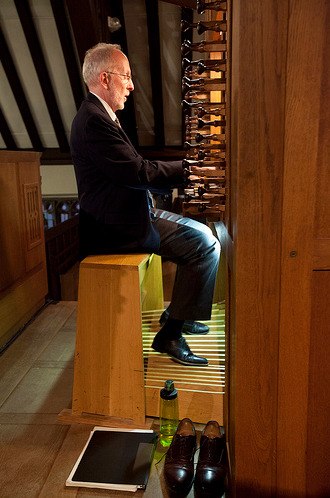
In speaking to John Corrie, who directs the Bates choir and is in charge of the organ, he raved about the beauty of the organ and likened it to fancy sports car. “In a sense it is sort of like a BMW car or an AUDI 8 that has every bell and whistle you could ever want…every time I sit down to play the thing it is this wonderful experience”. Corrie expressed how the donor of the organ, (the fifth Bates President Thomas Hedley Reynolds) did not publicize how much it cost, but obviously felt it was extremely important for the institution, as he did not ask for help fundraising. Corrie estimated that it could have cost almost one million dollars in 1982.
Dylan Lopez
The Chapel has always been a place where I have felt comfortable to express my inner spiritual self. It is a safe space where I come to sit and think. I went to the chapel to get a closer look at the organ after our conversation and was mesmerized by the sheer beauty of the instrument. It has a stained white oak case with the pipe shades hand-carved out of butternut wood. It is truly a state of the art instrument that evokes a feeling of a higher power due to its pristine beauty. The Chapel feels very inclusive to a range of religious and spiritual worldviews, the organ is the symbolic and physical manifestation of this inclusivity.
Courtney Doyle
As a member of the Bates college choir I have sung with the accompaniment of the organ on several occasions. Singing with an organ is very different from singing with a piano or a harpsichord. Each note can be held for a more extended period of time, and has the capacity to resonate more deeply than that of a piano. It produces such a full, majestic and complex sound on its own, which creates a larger challenge in blending not only with the rest of the choir, but with the instrument. Before every performance with the organ, additional rehearsals are required so that we can get used to its music. The first time I sang with the organ was for the annual service of “Lessons and Carols” hosted by the multifaith chaplaincy my freshman year. It is a service held in December for the advent season of the Christian faith, though all are welcome. Each year the chapel fills up and almost all of the college’s musical ensembles perform, between several readings and communal hymns. This has always been a time for me to take a step back from all of the finals week madness, and celebrate the season and the community.
Another service for which we sang to the organ was the dedication of the chapel to the late Reverend Peter J. Gomes in October 2012. For this event, Bates brought in a guest organist from Harvard University, where Gomes worked as a minister for several years. Along with joining the congregation selection of hymns, we rehearsed and sang what was known to be Gomes’ favorite psalm, 47:1 “O clap your hands, all ye people.” Not only was this a fun song to sing, but the service itself was wonderful. I learned so much about Reverend Gomes, one of the most distinguished members of the Bates alumni, through thoughts, prayers and musical offerings from people who knew him personally. This also kicked off the events in line for President Clayton Spencer’s inauguration, making for an overall monumental and celebratory weekend.
The organ also reminds me of a more somber event, the memorial service for Troy Pappas, class of 2016, also taking place in October 2012. Once again the chapel filled up as we remembered our fellow classmate through words, songs, and prayers. Although I did not know Troy, I could feel all of the love for him during that service.
All of these experiences have a few common links. For me, nothing evokes memories and emotions quite the way music does, and whenever the organ plays in the Peter Gomes chapel I feel the sense of community, celebration, and commemoration. I am brought to recognize certain aspects of the Bates community, that I may not always keep in mind while in the classroom or the dining hall. Nonetheless I value them, and am thankful that the organ is is there to remind me.