
Nice to Meet You, Betty Bates!
Evocative Essay: Laura Millstein
My first-year seminar was titled, “Visualizing Identities.” The professor was Aimeé Bessire, a scholar with a zealous curiosity for all aspects of art and visual culture. The course sampled a wide range of topics and cultures, emphasizing the importance of global study. Aimeé fostered my interest in personal perception through her introduction of several case studies. After reading through countless articles, viewing slideshows of modern art, even visiting the Olin Art Museum, our attention turned to the Muskie Archives. Located on a rarely traversed corner of the campus, across from the package center, the Muskie Archives are a hidden trove.
The archivist, Elaine Ardia, ushered our class into the lobby, requiring that we leave our bags and jackets behind. We filled out a rudimentary release form and obtained an official “Muskie” pencil. Upon entering the astoundingly small central room, I noticed that there were several artifacts strewn across the three communal tables. I chose a seat near my group of friends and we began looking at the items placed before us. Not knowing whether we were allowed to touch the items yet, we waited as Elaine introduced herself and stated the mission of the archives. She announced that before us, was a gathering of materials that alumni had submitted in the hope of preservation. When the time came to explore, my eye gravitated towards a collection of carefully organized booklets.
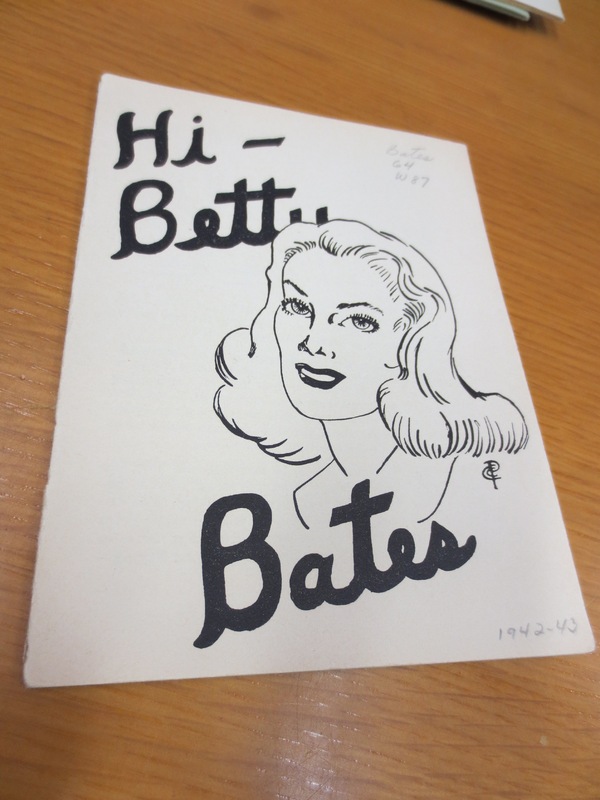
Reaching for the manila folder that contained them, I spilled the contents out onto the table. “Hi, Betty Bates” was embossed on one cover, “Welcome, Betty Bates!” was written on another. Different illustrations adorned each cover, all seemingly drawn by a thin-tipped pen. The more impressive covers included depictions of scenery around campus - the steps of Hathorn, or the Coram library. Others simply featured women dressed in vintage fashions, or glamorous close-ups of women with flowing hair and dark lips. Most of the booklets were printed on colored paper and modestly stapled at the seams. The contents of one booklet, dated 1957-1958 began as follows,
Before you reach the college, here’s a preliminary
greeting
From a portion of the people that you’ll very
soon be meeting.
And here’s our hand extended to new Betty Bates –
that’s you
With a welcome and a wish and a helpful hint or
two.
I then understood the booklets to be some sort of offering from the uperclass[women] of Bates College to the incoming girls. I had an instant personal connection to the subject matter, as I was a freshman at the time. It was fascinating to note how the incoming female freshmen were treated in comparison to my modern experience. The quaintness struck me as satisfying to read. The old-fashioned charm provided entertainment for my group and myself. Reading aloud from the booklet, we laughed at seemingly preposterous anecdotes and recommendations, which would seem out of place in a twenty-first century Bates.
The class trip to the archives ended shortly after my interest in the booklets peaked. I made a mental note to return someday and show these booklets to others who may find them interesting. It was like finding a jewel in the haystack of collected memories. I knew that I could not keep these items to myself, as they were far too fascinating to forget.
When my parents arrived on campus in the fall of 2010, (for my first parents and family weekend), I eagerly researched the operating hours of the Muskie Archives. My father was a history major at New York University and my mother studied art as an undergrad. I knew that they would enjoy the trove of fascinating artifacts. Recognizing a friendly face, I asked Elaine if it was possible to view the collection of Betty Bates booklets. She presented me with the large envelope, and I enthusiastically showed them to my parents. Both my mother and father instantly reminisced about the cultural epoch that was well preserved in these Bates artifacts. As a female who grew up during the late 1950’s – early 1960’s, my mother had a greater personal stake in recalling the fashions and phrases depicted in the booklets. Remembering how her mother, my grandmother, and family friends, dressed and styled themselves was a poignant memory. While my father also recalled this time period, he was less apt to connect to the history of the female students at Bates.
Although I was not alive during the 1950’s and 1960’s, I too relate as a female to the lifestyle and culture of women at the time of Betty Bates. My personal connection is tied to the oral history that my grandmother has passed along to me, as well as the interest in comparing life at Bates then to life at Bates now. It was not until my senior year at Bates that I truly pondered the significance of the Betty Bates decades of tradition. For a seminar on Material Culture, taught by Professor Myron Beasley, my group was tasked with selecting a uniquely “Bates” object to research. It was a natural thought that the booklets would work for this project, but I was unsure of all that I would uncover.
The divergent history of female culture at Bates in comparison to male culture at Bates has been a surprising realization for me. Derrick will touch on this idea further in his critical essay, however I thought it was important to note that upon initial inspection, I regarded the Betty Bates booklets as merely a form of historical entertainment. I viewed these colorful pamphlets as colloquial, humorous and heartening depictions of the quaint past. The critical lens of gendered norms has provided a more in depth reading of the artifact. The darling poems that I had copied down in my notebook…
The site of gang meetings
Gab sessions, and snacks.
Your room is the place
Where no liveliness lacks.
are now compared to the frank style of writing in the men’s booklet titled, The Straight Scoop, from the same era. The stylistic differences of these male and female focused freshmen pamphlets astoundingly defy the gender neutrality of modern society.
After revisiting the remarkable Betty Bates booklets on several occasions – from freshmen year through senior year – I have garnered a better understanding of the undergraduate women who came before me. The kinship that I feel as a woman to these, now historical, figures is enhanced and defined by my continued study of artifacts that detail the lives they led.