
A Look at Bates College in the Late Fifties
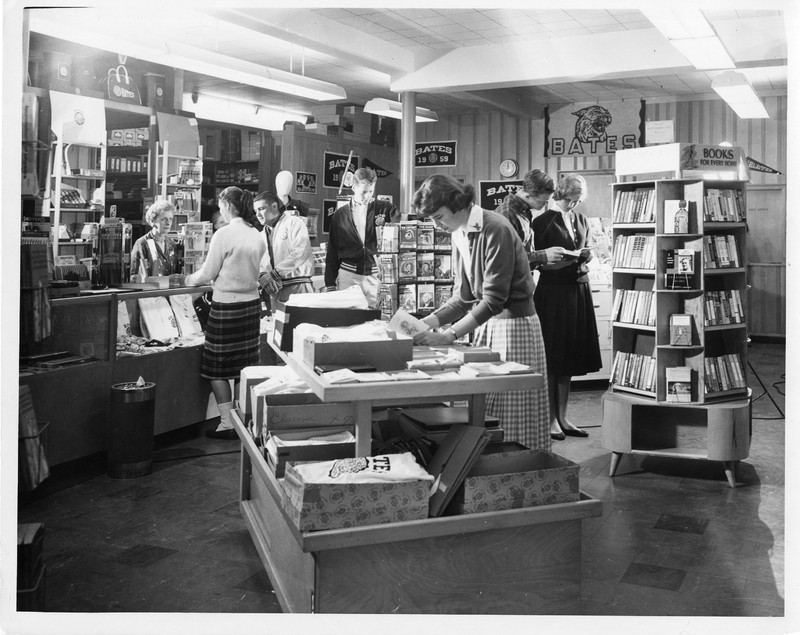
Historical Essay: Easton Morang
Over the years, Bates College has built itself a highly esteemed reputation as one of the nation’s most rigorous academic institutions. To add to this prestige, Bates was the first college to be coeducational from the moment it was established by abolitionists in 1855 (“About Bates”). Currently, Bates remains among America’s finest equal opportunity schools. Nonetheless, this equality was in no way immediate – rather, there was an extended and continual process that has slowly shaped the way things are today. A snapshot of this process can be seen through the lens of the late fifties, where women and men were considered to be equal, but in no way treated so. A case study of the 1957-58 Betty Bates handbook – a prescriptive pamphlet given to all incoming women – will serve as an integral part of the analysis of the social framework that existed during this timeframe. Even though institutional practices like the Betty Bates handbook presented an uneven playing field to women, they were still able to work through the system achieve success in unique ways.
It is best to begin with a brief account of the rigid framework that largely governed social life at Bates College during the late fifties. While women and men were allowed to attend the same classes, they were required to live in entirely separate dormitories on campus. Men occupied the “East Side,” which consisted of Smith, J.B., Roger Williams, Chase Hall, and much of Commons. Women therefore lived in the “West Side,” or Rand, Parker, and the houses that surrounded the campus (like Milliken, for example). When women were entering or leaving a dorm, they were required to sign in or out accordingly. Meanwhile, men were allowed to move about on campus as freely as they pleased. No alcohol was allowed on campus at all, and smoking was acceptable only in permitted areas. There was also a strict dress code in place for women that prohibited wearing slacks or shorts in class or in the dining hall. As one may assume, this did not apply to men either.
It is evident that Bates College was unquestionably more severe in the late fifties than it is today. The most intriguing aspect of this is the gender-based double standard. During this timeframe, such a style of institutionalized gender bias had slowly begun to evaporate around the country, but was still almost religiously enforced by Bates College. According to Bates graduate Joan Child (class of 1959):
- “At eight I had stopped believing in Santa Claus, but at eighteen I still believed that men and women were treated equally. That may have been so in high school, but somehow at Bates it didn’t work out that way… While the Bates man enjoyed relative freedom from such trivia as sign-outs and curfews, the Bates woman was carefully controlled with the psychology and peer pressure of the Woman’s Honor System.” (Child 1990)
The Woman’s Honor System was promoted by the Betty Bates handbook and enforced by the dorm house councils. These councils were composed of peer-elected dorm mates, but that did not bring any more equality to the equation – after all, men’s codes were considerably less strict. The Woman’s Honor System stipulated that all girls were required to report any infraction that they had committed at weekly meetings with the dorm house council. These infractions could range from something as frowned upon as missing a class (god forbid!) to forgetting a sign in or being just few seconds late to class. Other infractions could include missing the early nightly curfew or being tardy to one of the three required weekly Chapel visits. In her 1986 editorial for a Bates publication, Child succinctly sums it up, “As coeds we were well guarded from every imaginable danger, except the dreaded Double Standard” (Child 1990).
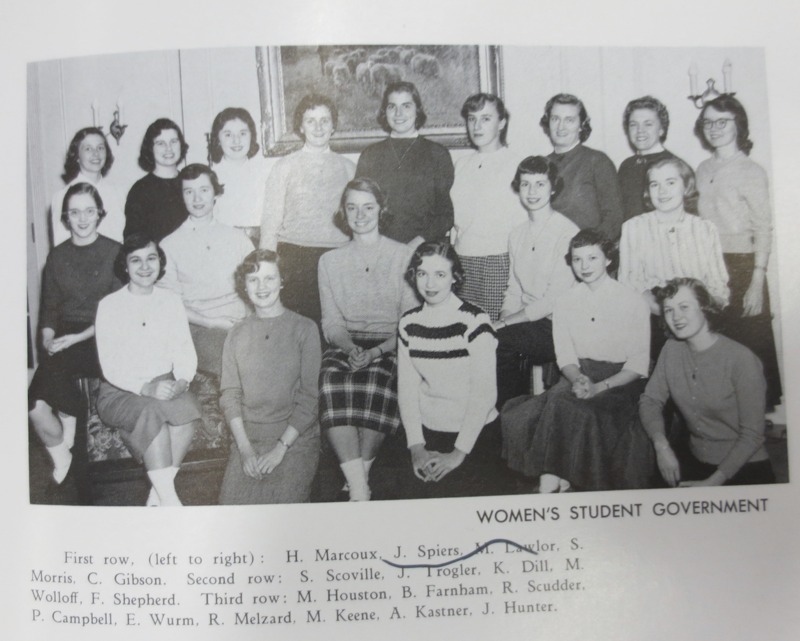
A look at the 1958 Bates Mirror helps provide further insight on the social structures that contributed to the “Double Standard” that Child mentions. The Student Council was composed of eleven people – all men. The Intramural Council was composed of eight people – again all men. Strangely, there was a group photo titled “Student Government Vice Presidents” on the same page, in a manner that seemed to place this group as supplementary to the all-male Student Council – and this group was entirely composed of females. Rather than having a single, unified student government system in place, women were marginalized into forming their own organization to try to maintain at least some of their rights. It seems that this system was not providing enough gender equality, so women had to form yet another organization, called the Women’s Student Government.
Such a separation speaks volumes towards the social makeup of Bates during the late fifties. While the college maintained the positive academic attributes that have continued to solidify it as one of the nation’s top colleges, during this era the gender equality was clearly feigned. The existence of both a men and women’s student government seems equal on the surface, the men’s organization was clearly the head of it all. Evidence exists in details as simple as the group’s respective titles: the men’s group was considered the unofficial “main” overarching governmental body, labeled as the unlimited “Student Council,” while the women were constrained to their own business as the “Women’s Student Government.”
Additional information may be gained from the Mirror’s athletics section for 1958. According to the yearbook’s editors, “The Women’s Athletic Association at Bates provides a balanced program of sports and special events for the women” (McRae et al. 1959). However, the women’s athletics section is only two pages with about ten sentences of description to cover the entire year. The men’s section, on the other hand, is ten pages long. It also has a dedicated section for each sport: golf, tennis, spring track, winter track, baseball, football and basketball. These sections include detailed accounts of scores and highlights for every game played. Once again, there is a weak attempt made to make Bates seem to be equal, but a disconnect still exists, especially when examining the titles. The section labeled “Sports” is composed of entirely male activities, while the women are cornered into their own category: “Women’s Athletics.”
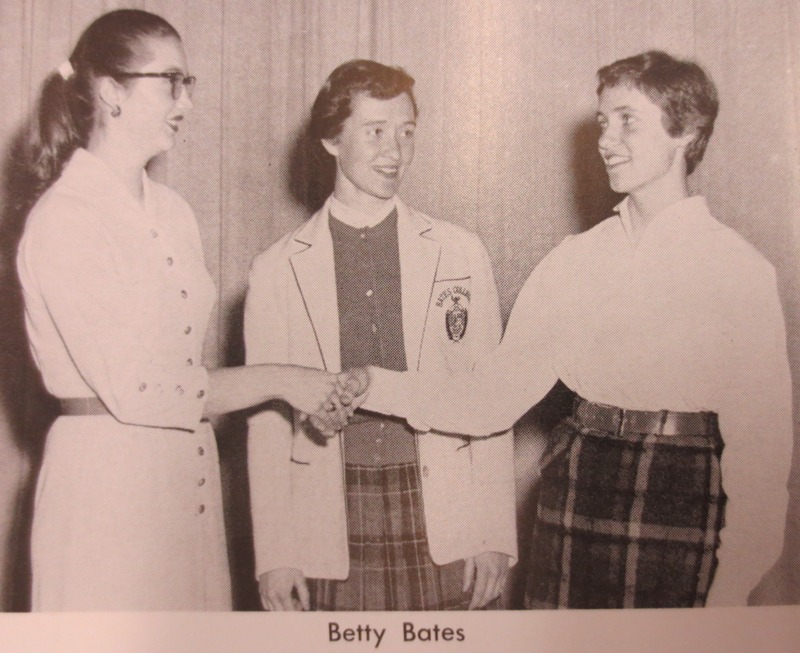
Moving on, it is interesting to see how the Betty Bates handbook interacts with and complements the social environment of Bates during the late fifties. While the handbook begins with a very open-minded and friendly introduction, the following material instantly works to establish a marginalized female identity for Bates women. For example, the first sentence after the introduction is, “Your biggest item of interest is probably clothes." The pamphlet then goes on to specify the appropriate female attire in excruciating detail, down to the suggestion, “Don’t be attracted by a novelty which you will never use because it’s the wrong shade for the rest of your wardrobe." While there are indeed useful tips that would help incoming freshman fit in with their peers, these tips do so at the expense of some aspects of individual personality.
For instance, the Betty Bates handbook spends a large amount of time attempting to prescribe how to behave, and often veers into the territory of behavior that is often governed by one’s unique disposition. The sentences, “… don’t let your friendship become a closed corporation; don’t be labeled as a member of one small select group,” may seem like intimidating commands to more shy or introverted freshman females. According to Betty Bates, there is a specific mold that each woman is expected to fit into. It seems that the process of fitting oneself to this mold nearly takes prevalence over academic performance. Rather than suggesting to find creative and progressive ways for a woman to make a name for herself, Betty Bates suggests that, “… a smile gets you lots of places. This is a very simplistic take on the variety of paths to success that are available to women, and suggests that there are different definitions of success based on gender.
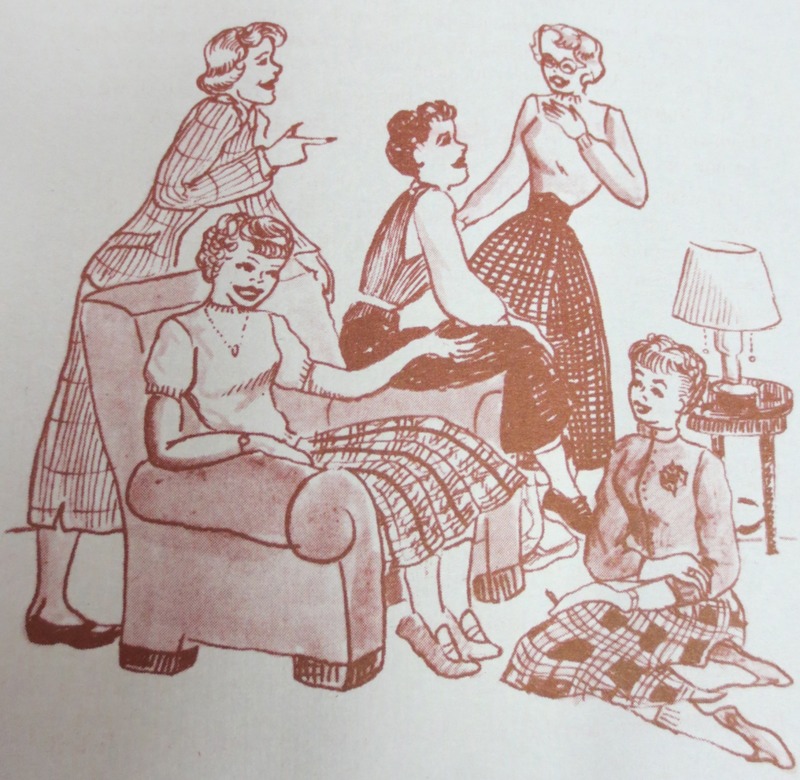
Finally, the Betty Bates handbook discusses its “most important subject… the Honor System. The handbook reveals the details of the function of the honor system, but paints it in quite a different light than Joan Child did. According to the Dean of Women Mrs. Clark, “The Honor System gives each girl the privilege of self-direction and… has been designed to give each individual the greatest opportunities for personal development and social contribution." This is a glaring instance of political spin – personal accounts like Child’s show that the vast majority of women did not agree with this so-called “privileged” system whatsoever. In reality, the system was deeply flawed, and used the concept of social responsibility to make each woman feel accountable for her actions to the point of paranoia. The Betty Bates pamphlet constantly tricks its readers into believing in the methods of the Honor System with phrases like this: “It is not just a mean way of initiating you, although there will be frustrating times when you will certainly think it is! You will be thankful for it…" Such is the psychological control that the Betty Bates utilized to create a basic and unified female identity from which men could “select” their future wives.
Yet, there remains a silver lining. Often, when faced with biased circumstances like these, people are able to find their own methods to beat the system and strive for success. As Child put it, her most useful knowledge, “…did not come from the class lectures or the library as I thought it might… from the first my Bates education taught me to rebel silently” (Child 1990). Thus, the rigid restrictions that were enforced on the women’s side of campus did not necessarily force every single woman into the neat box that the Betty Bates handbook wished. Rather, women found their own ways to find enjoyment within (and sometimes outside of) the boundaries. Largely, women learned to question what they were taught, and to not blindly take everything for face value. At a time when many women considered college as a desirable place to “find” a husband, Bates women were “generally looking for other things” (Child 1990). This presents a somewhat positive outcome as a result of a not-as-positive situation.
In conclusion, Bates College was an entirely different place in the late fifties. Rules were firmer in general, but largely only enforced on the women’s side of campus. Equality was attempted but poorly demonstrated, as the 1958 Bates Mirror shows. And, institutional programs like the Betty Bates handbook presented an incredibly narrow and basic female identity as desirable for women at Bates. Nonetheless, these confinements did not entirely extinguish the spirit of women – in fact on the contrary. Bates women worked with what they could and managed to find ways to progress towards the level of achievement and equality that is seen at Bates today.