
Critical Narrative
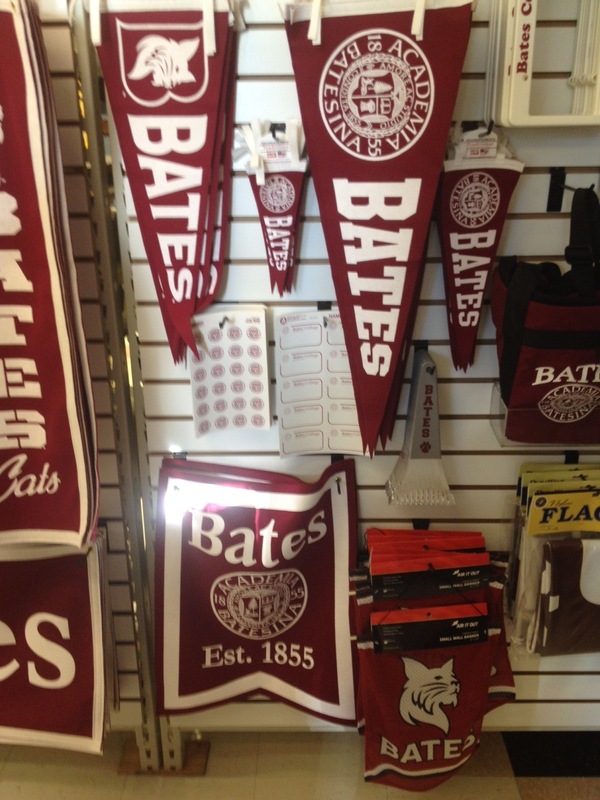







The Bates College seal is an image containing symbols that are significant to the core values and ideals of the institution. Although several descriptions of these symbols and their meanings exist, little is known about their symbolic meanings or why they are oriented in such a specific manner. The seal was originally intended to brand official college documents and forms. However, it has frequently been used to mark various items that do not seem to follow the guidelines for its official use, as are described in the Bates College Graphics Standards Manual. A semiotic critical approach to analyzing the seal suggests that because its symbolic meaning is not completely understood, much of its understood significance may be subjective. Analyses of the meaning behind the seal reflect a fair deal of subjectively ascribed significance, which is related to the frequent use of the seal in an unofficial manner. Ultimately, this results in a collective consciousness that has been conditioned to the image of the seal, and is therefore disengaged with its symbolic importance to Bates College.
Semiotic Approach
According to Berger, semiotics is the science of signs, which are objects or symbols that stand for certain things. Semiotics specifically considers what these signs are and how they function as signifiers for their associated connotations (Berger, 39). College seals in general are images that are synonymous with the institution with which they are associated, much like a logo or mascot. However, whereas one of these may be used to mark athletic uniforms, for example, the seal is designed to encompass the academic institution’s core values and ideals through various symbols, all of which are contained in one unified image. Berger specifically highlights the major theories of Saussure, one of the founding fathers of semiotics, specifically emphasizing the notion that the relationship that exists between “signifiers” and “signifieds” is arbitrary (41). In other words, when examining an object, its literal or physical meaning may be fairly obvious to the examiner. However, when viewing an object as a sign and therefore considering its deeper associations, its meanings may not be immediately evident. It may be impossible to know exactly what an object signifies, as these ideas may be open to a fair degree of interpretation.
In regards to the Bates College seal, a concrete record of the meanings behind its symbols has not been procured. Consequently, deductions as to what each symbol definitively stands for are mostly founded in conjecture. Specifically, many of the supposed meanings have only been supported by either what is known about similar symbols that other colleges use in their seals, as well as what these symbols have traditionally signified in history. This is significant because of the fact that our current understanding of the Bates seal and its symbols is the product of a fair degree of speculation. Because of this lack of proven significance, any analysis or claims about the seal may be nothing more subjective.
Similarly, Berger emphasizes the ideas of Pierce, another founding father of semiotics. Pierce argues that the universe is made up of signs and that those who interpret these signs have to supply some of their meanings (Berger, 44). This reflects the idea that when an object’s purpose or significance has not been concretely defined, as is the case with the Bates College seal, we tend to ascribe our own meanings and significances to these objects. Interpretation of the seal is therefore different for everyone. For example, according to the Bates College Graphics Standards Manual, “the Bates College seal is reserved for limited official use. It appears on documents and ceremonial materials produced by the President’s office, such as certificates of merit, diplomas, formal invitations, and official flags. The seal also appears as a watermark on the College’s general letterhead…Requests for special applications of the College seal should be made to the Publications Office (Bates College Graphics Standards Manual, 5). Despite these regulations on the official use of the seal, the image can be found in numerous places that do not seem to meet the restrictions described in the Graphics Standards Manual. Specifically, in the College book store, the seal can be found on a collection of objects that include, but are not limited to, golf balls, Christmas ornaments, key chains, disposable pens, car decals, shot glasses, and which are intended specifically for the consumption of alcohol. In regards to the idea that the interpretation of the seal’s significance is subjective, it is evident that there is likely a stark contrast in interpretations between those who value the official regulations surrounding usage of the seal and other individuals, such as students who may buy a shot glass marked with the seal, for example. In other words, such a student may not realize the significance of the seal’s association with the core values and ideals on which their education is founded.
Saussure also argued that we find meanings in concepts (or symbols, in this case) by framing them in relationship to opposing concepts, that is to say, concepts derive their meanings from their opposites. For example, happiness is only meaningful as the opposite of sadness, and healthy is only meaningful as the opposite of sick (Berger, 42). This notion is indicative of the idea that in considering the meanings of objects, it is important to consider what an object is not, that is, considering how the object differs from things that are not that object. Also, it is important to consider the fact that the seal’s purpose differs depending on the item on which it is located. The seal appears a many different kinds of items, many of which do not seem to meet the standards set forth by the Graphics Standards Manual. This is significant because of the frequency with which the seal has been produced on objects other than official college documents, which undermines the significance of the seal as a representation of the college’s values. Specifically, this is evident when considering the bookstore merchandise described above. The result is a sense of banality directed towards the seal—a product of the frequency with which members of the Bates College community are exposed to the seal, which happens to be so often that these individuals are conditioned to its image, which therefore loses its symbolic meaning. Essentially, the seal appears so frequently, especially in manners that do not reflect its association as an official symbol of Bates College, that its visual and symbolic aspects are virtually unnoticed.
Marxist Approach
Approaching the seal from a Marxist perspective reinforces many of the ideas described above, especially in regards to the fact that the seal is branded on much of the merchandise sold in the Bates bookstore. One of the leading Marxist economic theories states that because of capitalism in the modern world, people are driven to purchase things because of alienation. This alienation is associated with the perception of an artificial need to consume in order to achieve a satisfaction by obtaining many possessions relative to others. These needs are not real, but are rather instilled in our minds by advertising and marketing strategies, which aim to convince us that we need to purchase their product to achieve happiness, whether or not we actually do (Berger, 67). The seal is supposed to represent the values and ideals of a prestigious academic institution, yet the fact that it appears on so much merchandise suggests that it is intended to be consumed. However, in the process of this purchase, the consumer becomes alienated from the seal’s symbolic significance. In other words, when an item branded with the seal is purchased, the monetary value of the item on which the seal appears obscures the symbolic value associated with the seal itself. Consequently, the ideals represented by the symbols are undermined by this act of consumption.
Many Marxists consider advertising to be the primary means of promoting consumer culture in capitalist societies (69). In a sense, the act of branding Bates merchandise with the College’s seal is a form of advertising. Specifically, it presents the college’s name and values with the intention of selling merchandise, and thus promotes consumerism. However, this is somewhat disconcerting because the college’s intention is not to promote its core values and ideals, but rather to encourage consumption of its merchandise, regardless of whether or not the buyer recognizes the symbolic importance of the seal.
Because the symbolic meaning behind the Bates College seal is only supported by conjecture and is therefore not completely understood, it has been left open for much interpretation and subjectivity. A semiotic critical approach to analyzing the seal suggests that because its symbolic meaning is not completely understood, much of its ascribed significance may be subjective. Also, the frequency with which the seal appears on items that are not consistent with its official purposes results in a sense of banality by which members of the Bates community are conditioned to the seeing the seal, and therefore do not actively reflect on its significance. Similarly, a Marxist approach to understanding the seal suggests that the act of branding material goods with the seal with the intention of turning a profit undermines the symbolic value of the seal by emphasizing the monetary value of the item on which it is branded.
Sources:
Berger, Arthur Asa. What Objects Mean: An Introduction to Material Culture. Walnut Creek, CA: Left Coast Press, 2009. Print.
Graphics Standards Manual. Lewiston, ME: Bates College, n.d. Print.