
Historical Narrative
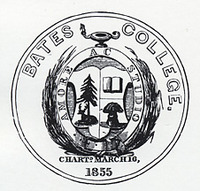
Little is known about the history behind the Bates College seal. In the Bates College Muskie Archives there is no information about who originally designed the seal, what the images on the seal symbolize, or why these symbols are included in the seal. Shockinkly, when we attempted to do preliminary research for this project, one of the archivists in the Muskie Archives encouraged us to avoid researching the Bates seal due to a lack of information. This archivist (who is obviously much more experienced in the field of historical research) took on similar research questions not long ago only to discover frustratingly few results.These absences are somewhat shocking, considering the seal can be found on so many documents and other objects throughout campus. It is truly amazing that such a critical symbol for Bates College lacks so much historical information.
Before going into a more detailed description and history of the Bates College seal, it is important for us to gain an understanding of college seals and their meanings generally. Today we see seals that aim to represent the overall character and strengths of nearly every college and university across the country. However, in ancient times, seals were used as recognizable marks that often replaced signatures (as far less people were literate in ancient times). In other words, seals were used to authenticate official documents.
Similar to the way seals were historically used to authenticate documents, it is common for academic institutions to indicate that college seals only be included in formal and legal documents such as diplomas. Bates College indicates this in the Bates College Graphics Standards Manual, where we see that, “In order to strengthen the recognition of the signatures as the main identifiers for Bates College, the Bates College seal is reserved for limited official use. It appears on documents and ceremonial materials produced by the President’s office, such as certificates of merit, diplomas, formal invitations, and official flags. The seal also appears as a watermark on the College’s general letterhead”(Graphics Standards Manual). As we will see in other sections of this website, this high standard does not seem to hold and there are clear deviations from this rule in present day. However, for fear of being too redundant we will leave the details of these exceptions to the Evocative section.
Like we've explained earlier, there is very little information about the seal itself. One of the few things about the seal we actually have a concrete understanding of is the Latin text that appears along the top of the seal. One might wonder why Bates, as well as many other academic institutions, uses Latin. Since the United States is a primarily English speaking society, it would seem to make sense that English would be the only language seen on the seal. One reason for this use of Latin may be fairly obvious: Latin is a language of great tradition that is often associated with higher education and scholarship. However, a less obvious reason for the inclusion of Latin lies in the fact that Latin is a dead language. Therefore, the “words do not change in meaning, become unstylish, respelled or slang for something unintended. They stay fresh” (Farnon, 1990).
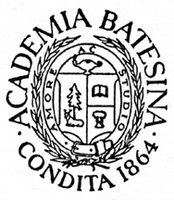
Along the top of the seal (just under the word “Academia”) we see the Latin words “Amore Ac Studio” written within a belt that surrounds the images within the seal. These words represent Bates’ motto, a short phrase that attempts to encompass the major characteristics and goals of Bates College (which is also the purpose of the seal). According to the 1877 Bates Student, the Founder and President of Bates College at the time (President Oren B. Cheney) wrote to the renowned scholar and philanthropic United States Senator from Massachusetts, Charles Sumner (with whom President Cheney had a political relationship) in 1857 asking for suggestions for a motto for Bates College. This is of great significance, as students (especially at the time of the motto’s inception) could take great pride in knowing that their school’s motto was penned by such a prominent political figure. This fact certainly seems to legitimize the school’s motto and the seal it appears on. Mr. Sumner responded to this request with a letter reading, “My Dear Sir,- Amore ac Studio. I cannot send anything better than these words for the seal of your institution” (The Bates Student, 1877). According to this volume of the Bates Student, these Latin words can be translated to “with ardent zeal for study.” The Kennebec Journal of 1858 describes the meaning of this Latin in a little more detail (and probably using some poetic license): “with love and zeal for the scholastic pursuits for which the Seminary [now Bates College] was instituted” (Kennebec Journal, 1858). Bates’ motto within the seal is of great importance not only because of its high source (United States Senator), but also because of its emphasis on academic pursuits, which remains a major quality of Bates today.
It is important to understand that similar to Bates as an institution, the seal has undergone a number of alterations throughout its history. Although these modifications are not drastic and the seal has not strayed far from its origins, the changes are certainly noticeable. We do not have extensive records of exactly when and how the seal has changed over the years in terms of style. One can notice distinct alterations to the design of the seal by looking at different images of the seal that have been in the Bates Student over the years, but the only concrete information we have about redesigns of the seal come later in Bates’ history, which we will discuss more in depth shortly.
One noteworthy change to the Bates seal deals with its actual physical form. At its inception, the seal was engraved on a woodcut. As stated before, the seal would have been used to stamp authority on official college documents. Since then, we have obviously seen great technological advances, and the seal now is a digital image that can be printed at any time from any printer, and is seen throughout campus.
Another transformation deals with the words “Academia Batesina,” which appear at the edge of the seal. The original seal included the words “Bates College” in English along the top of the seal. Since then, we see the transition (possibly in the 1870s) to “Academia Batesina,” which uses a Latin form. Concrete reasons for this are unknown, however we might argue that this alteration was executed based on similar reasons that we described earlier justifying the Latin motto. Also, it may be the case that this variation of the school’s name occurred to introduce uniformity of language in the seal.
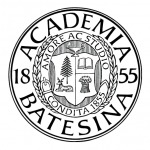
The most notable alteration to the seal deals with the date at the bottom of the seal. When the Bates seal appears in the Laws of Bates College, With the Legislative Acts Having Relation to the Institution, printed in 1864, it includes the “Chart. March 16, 1855” at the bottom of the Seal representing the establishment of Bates College. This is the date when the Maine State Seminary (the beginnings of Bates College) first received its charter from the Maine Legislature. However, in the 1870s President Cheney began using 1864 as the date of establishment, as this was the year that The Maine Legislature changed the school’s name from “President and Trustees of Maine State Seminary” to “President and Trustees of Bates College.” However, archives of the Bates Student show that in volumes from 1877 to 1903, the seal contains “Condita 1863” across the bottom of the seal. This was the date that Bates first received its college charter and offered college instruction. In 1904 we again see March 16, 1855 as the date of establishment. After this, 1863 is again used until 1911. After this the seal is no longer found in the Bates Student until 1955. However, In Mirrors, (the yearbook) between 1918 and 1930, we see seals with “Condita [founded] 1863,” while others include “Condita 1864″ and still others go back to “Chart. March 16, 1855.” Beginning in 1955, the Bates Student began using “Condita 1864” across the bottom of the seal until a 1981 issue used “Condita 1855,” again going back to the original date of the charter of the Maine State Seminary. In the 1980s, Bates President Thomas Reynolds pled with the Board of Trustees to use the 1855 date as the date on the seal. In regards to this permanent change, President Reynolds stated, “Like all colleges I know of, Bates takes its proper founding date from the founding of the corporation, regardless of later changes in name or modifications of purpose” (September 1857: The Maine State Seminary Opens). Reynolds backed this claim further when he noted, “Mount Holyoke was founded as a women’s seminary in 1836. It did not become a college until late in the 1800s. It uses 1836 as its founding date. Princeton began life as the College of New Jersey. It uses the date of that institution as its founding date” (September 1857: The Maine State Seminary Opens). In the early 1990s, the seal was redesigned by a Bates Committee and graphic designer, Malcolm Grear, to make the seal more circular in shape. This is the seal we see around campus today. (September 1857: The Maine State Seminary Opens).
While there have been a number of noteworthy changes to the Bates seal over the years, it has always contained the same images (of which we do not have concrete meanings) and the same school motto. Although obviously lacking a great deal of historical knowledge, the seal has always been a symbol of Bates’ identity as an institution.
Sources
Copied from a Kennebec Journal printed at Augusta, Maine, Jan. 8 1858. Batesiana-
Subject Files. Box 8. Edmund S. Muskie Archives and Special Collections
Library, Bates College, Lewiston, Maine.
Farnon, Harry T. "More than You Probably Ever Wanted to Know about College Seals
and Mottoes." The Classical Journal 85.3 (1990): 254-59. Print.
Graphics Standards Manual. Lewiston, Me: Bates College, n.d. Print.
Mower, Francis, and J. Wesley Hutchins. "Editor's Portfolio." The Bates
Student [Lewiston, Me] n.d., 1877 Volume 5 sec.: n. pag. Print.
"September 1857: The Maine State Seminary Opens." Bates.edu. Bates College, n.d.
Web. 19 Nov. 2013