
Evocative Narrative
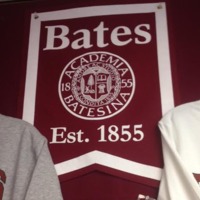

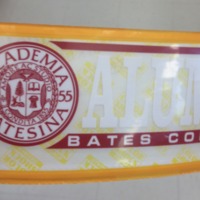

As our research began in the Muskie Archives, we came across a disturbing discovery: there are virtually no records about the Bates College seal. No one is aware of what the symbols represent, who the artist was, why the specific colors were selected, or why the Latin phrase was chosen. This is shocking because the seal is used and seen all over campus and on important college materials. It used on diplomas, official school documents, ceremonial stages, athletic jerseys, folders, notebooks, furniture, yearbooks, etc.; yet, no one knows the meaning behind the seal. This news was very upsetting to our group. Through our experiences, Bates seems to pride itself on deep tradition that dates back to 1855. Bates advertises the fact that they were one on the first colleges to accept all types of people, regardless of race, gender or personal beliefs. With this being said, shouldn’t the college want a seal, a representation of the core beliefs and values, to mean something? We feel that it ought to be a symbol of the college’s mission statement, something that we have all read and heard during our years at Bates.
Just last year the archivists conducted research in regards to a professor’s inquiry about the seal. They were equally as surprised to find such little data about this subject. The absence of information made us question the college’s core values because we have been looking at this seal for years now and we had the impression that it held significant meaning. Such questions arose as we began to dig deeper into the archives and because of the striking resemblance to a family’s crest. Some families have crests that date far back to history as it was often used on helmets during times of battle. The symbols on this crest were picked carefully, with certain animals, colors, and words chosen to depict a family’s power and core beliefs. Because of this comparison, it was disappointing to find that Bates did not take the time and effort to note how and why this seal was created. While also doing research online, we found that other schools have written out exactly why they depict particular symbols on their seal. For example, Amherst College and Dartmouth College both have easily accessible web pages displaying their historical records that track their respective seals throughout the years. They also have specific reasons as to why such logos and phrases were chosen. As Bates is often in comparison with such top schools around the country, it is expected to know about such valued information.
One member of our group attended a private catholic school, Xaverian Brothers High School (XBHS), in Westwood, Massachusetts. This school was a Xaverian Brothers sponsored school that traces its origins to St. Franics Xavier with his mission of evangelization through the ministry of education. There are several schools across the United States that are associated with the Xaverian Brothers; yet each was unique in the fact that each school has their own identity, history, and tradition. This is seen as each school has their own seal. While at XBHS, there was a founder’s day and gatherings dedicated to the history of the Xaverian Brothers and why we were sponsored by this religious organization. Four founder’s days over a high school career force you to know the history and meaning behind the school. After explaining how one high school treated their seal and their history, the other group members were shocked that a college, especially a prestigious one, does not compare. As he came from a place where history was cherished in the seal and their logo, it was much different for him to come to Bates and watch how they act so careless with their seal. It was particularly different to see a college speak so proudly during their tours and admission process, yet never mention it during the four years at the college.
Even though we compare Bates’ seal to other college seals, a high school seal, and family crests, we are most disappointed in the fact that the college uses the seal as if they were aware of its associated meaning. It was very easy to see this last year during the time of the presidential inauguration. As you walked into the gymnasium where the inauguration was held, you saw the seal on: flags hanging from stage, lights reflecting onto the floor, two massive projectors, and on the banners around campus. Although none of us personally knew what each symbol meant, there was an understanding that it was special because it was displayed so often during this time. Our group has agreed that we would never put something up on our walls, or display an object in front of guests if we had no distinct ties to that object. Imagine hosting a dinner party and someone asks you what that particular piece of art meant to you. Would you be embarrassed if you had nothing to say back? Would you then think twice about displaying objects if they have no meaning or value to you? These questions came to mind after finding out that college has no concrete idea as to what the seal means. Yes, there is conjecture; but with such an object that has prestigious connotations related to it, more than conjecture is expected.
We also found that not only is Bates unaware of what the seal symbolizes, but they also break their own rules in regards to the use of the seal. Not only does Bates not know of its origins, but the inconsistencies of their rules are unsettling. According to the college’s own style guide they state, “In order to strengthen the recognition of the signatures as the main identifiers for Bates College, the Bates College seal is reserved for limited official use. It appears on documents and ceremonial materials produced by the President’s office, such as certificates of merit, diplomas, formal invitations, and official flags. The seal also appears as a watermark on the College’s general letterhead.” The red ink in the style guide is meant to stand out, showing the importance of using the seal in select times to retain its significance. But, as previously stated, the seal can be seen everywhere.
The fact that you can buy wine and shot glasses, ping-pong balls, bumper stickers, and chairs with the seal being the main decoration on these objects demonstrates that the seal is not being used to display what the college represents. In the bookstore, the seal is used to sell merchandise. On athletic jerseys, the seal is used as a logo to ad flare to the jerseys. In the yearbooks, the seal is seen as a background on many pages almost seen as filler. Yet at the same time, it is used on diplomas and was displayed on stage during the presidential inauguration. There are times when the seal is used “properly” and times when it is not. Our group is wondering if the constant site of the seal, questioning if it is overused, is diminishing its effect. If the seal were just on one’s diploma, or only seen during graduation, that would make its appearance special. It would become more of a symbol of great importance and achievement rather than another site found at the campus bookstore.
Seeing the college seal on a shot glass is clearly going against the Bates style guide, as it is not being reserved for limited official use. It goes against the point of using the seal to represent the college for “official use” while students are seeing the seal while consuming alcohol. Upon reflection, our group is wondering why there is a style guide in the first place. As the seal is seen in many, many more locations other than the “limited” settings it is supposed to be in, then why is there a statement highlighting how it to be intended for. We also had questions as to who was monitoring the use of the seal. The style guide addresses this by stating, “the seal has been drawn to allow for maximum clarity and visibility and should not be altered in any way. Requests for special applications of the College seal should be made to the Publications Office. Reproduction copies or scanned versions for the computer are available through this channel.” We are wondering how the Publications Office is able to keep an eye on how the seal is used, and we are curious as to who can be part of this office. As there is a clear statement addressing the importance of revealing the seal on a limited basis, one has to wonder if this office has lost control of its use or if it is simply allowing the seal to be portrayed over campus. There is an absence of information in regards to who is on such a committee that is in charge of designating of the seal’s use and purpose. One questions if a more rigid system would lead to more control over the display of the seal.
Originally each member of our group was upset about the lack of information and significance of the college seal. However, we took another look at Bates and what Bates means to the students today. We found similarities that date back to the founding of the school. In 1855, as stated previously, Bates was built upon the foundation that any student was welcome. This idea of acceptance would allow these students to be themselves and express their own practices that may be looked down upon by others. They were allowed to be individualistic, just like students are encouraged to be today. In the 2013 Bates College, the admissions office is looking for diverse people - people that are interesting, can bring new and fresh ideas, and can express who they truly are. Bates wants students who will create their own clubs and will add something to the campus. As in 1855 the college does not discriminate against race, geography, religious beliefs, sexuality, or gender. Thus, the characteristics that the college was built on still exist today. Thinking about how Bates invites one’s individuality to show we are beginning to wonder about the few records found on campus. One theory is that Bates does not want any information about the seal to be found. This would force students to be creative in regards to thinking about what the seal could mean. The deer and tree symbols could mean one thing for me and could carry an entirely different meaning for my classmate sitting next to me. In this sense, the interpretation of the seal is completely up to the individual. Bates may be hoping for each student to have a unique experience during his or her four years, then buy materials from the bookstore, and finally look closely at what Bates truly meant. Even though there is no evidence to support such a theory, it is a positive way of addressing the missing information of this prestigious representation.
Like anything that happens in life, there will be memories. Attending Bates College for four years is an opportunity that most people would kill for, presenting one with a chance to excel in and outside of the classroom while making friendships that will last a lifetime. However, once your time at Bates is over with, what does it mean to you? Does is serve as just a memory of the best time of your life? Do you consider yourself lucky to put such a top liberal arts school on your resume? The Bates College seal is something that signifies the future for a student. As does the logo, the seal does indeed change with time. Being held high with such elegance, the Bates Seal is placed on items all around campus. Although the Bates seal struggles with the true meaning behind the structure of it, the overall message is something that continues with you post gradation. When looking back, the Bates Seal will able to mean whatever a student wants it to be. Graduating form a liberal arts college serves you with great purpose to think outside the box, and to think creatively.
The hours and hours of studying signify the book. The pine tree is a sign of Maine. As Bates is located in Maine, there is a need to recognize all that is around. Maine is a beautiful state, and Bates students are able to take full advantage of everything the state has to offer which ranges from miles of forest, beaches and mountains. The overall shape of the seal is a circle. A circle can mean a variety of things, but I believe that the circle symbolized unity. By attending a 4-year institution a student is committing himself or herself to every aspect of being a college student. There are many ‘firsts’ for a student including living away form home. I believe that circle represents that everyone that is involved in the campus is in it together and is united by the sense of a community feeling.