
A Family Bulletin Board
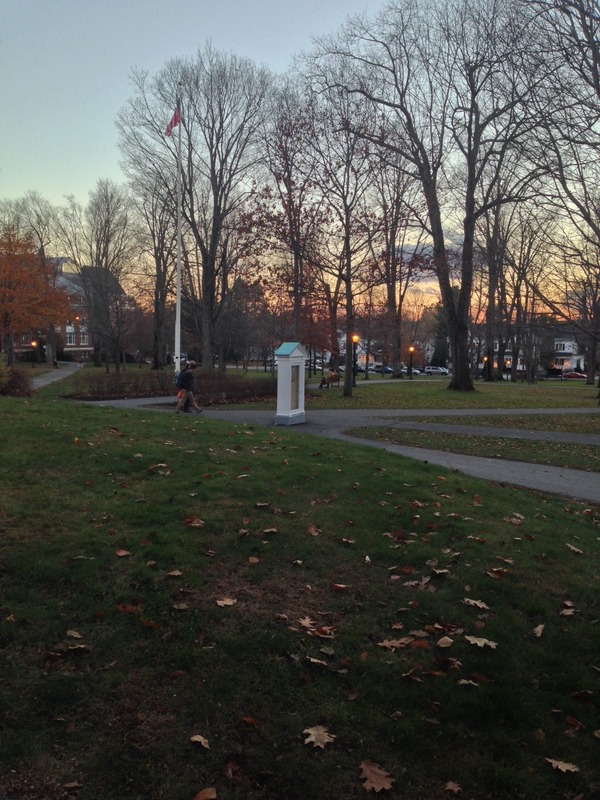
Since being at Bates I have never really found the Mouthpiece to be of much importance or significance to me. I noticed the physical object of course, but never spent any time thinking about what it meant to this college, the transition of technology, and to myself. The mouthpiece was irrelevant to me. I never saw anything posted on it, and had never been told about important information being posted on it. After reading Sherry Turkle’s Evocative Objects, talking about the significance of things in class, and researching the Mouthpiece at the Bates Archives, I began to think about the Mouthpiece in new light. As mentioned earlier, I thought about the general meaning and significance of the Mouthpiece. How it represents change in the Bates Campus’s physical appearance, how it represented a change and advancement in technology in general, and how it represented a change in the everyday life of a Bates College student. I thought about how the Mouthpiece used to be the center of campus, how much the school has expanded since its addition to the college, and how students used to gather around it to find out information about classes, and other general campus news. This made me think about how much easier it is to get information today at Bates with the rise of the Internet and technology, and the creation of the announce email. I began to view the announce email as the modern day mouthpiece. The brackets around the word “[announce]” represent the physical figure of the announce email, and the information in the emails providing information of campus events and classes, represent the purpose of the Mouthpiece; which was to provide students with a general spot to receive information. But besides thinking about the Mouthpiece and its significance to Bates, I began to connect with and think about the Mouthpiece on a more personal emotional level.
Inside the Mouthpiece there is just a plain cork bulletin board. The white, rectangular box and glass cover make the bulletin board look majestic and of importance, which it once was, but inside, it just a normal bulletin board. Realizing this I thought back to the only other bulletin board that really had any significance to me, and that was the one hanging above the kitchen table in my childhood home. I used to look at that bulletin board everyday. I ate my bowl of cereal for breakfast at the kitchen table and looked up at the calendar that my mom had posted (and updated almost everyday), and I looked at all the awards, and art projects that my sisters and I had received and created. The bulletin board was an absolute mess. Drawings, news clippings, awards, messages were posted everywhere on it, and they were constantly changing or getting ripped off from someone brushing by it. Although messy, and sometimes hard to understand (especially for non-family), the bulletin board served as a way for my mother and father to communicate with the family and others that visited the house. We tried to have family dinners often and discuss matters and schedules then, but people were quite busy around the house and didn’t always have a chance to talk to the family about plans, so my mom would post our doctors appointments and other important plans on the bulletin so everyone would be on the same page. My father and her would also post interesting news articles that they wanted to share with the family, and awards and school projects to show friends and visitors how proud they were of their three children, which I hope they still are. After thinking about the Mouthpiece through the lens given to me by Turkle and our class discussion, I began to realize how much the Mouthpiece means and how it even reminds me of home. Now when I walk through campus I look at the Mouthpiece and think of the bulletin board above my kitchen table, and the transformation of Bates College. It actually means something to me, instead of being just an irrelevant structure of cork, glass and wood.
- Michael Bernstein
Turkle, Sherry. Evocative Objects: Things We Think With. Cambridge: The MIT Press, 2007